

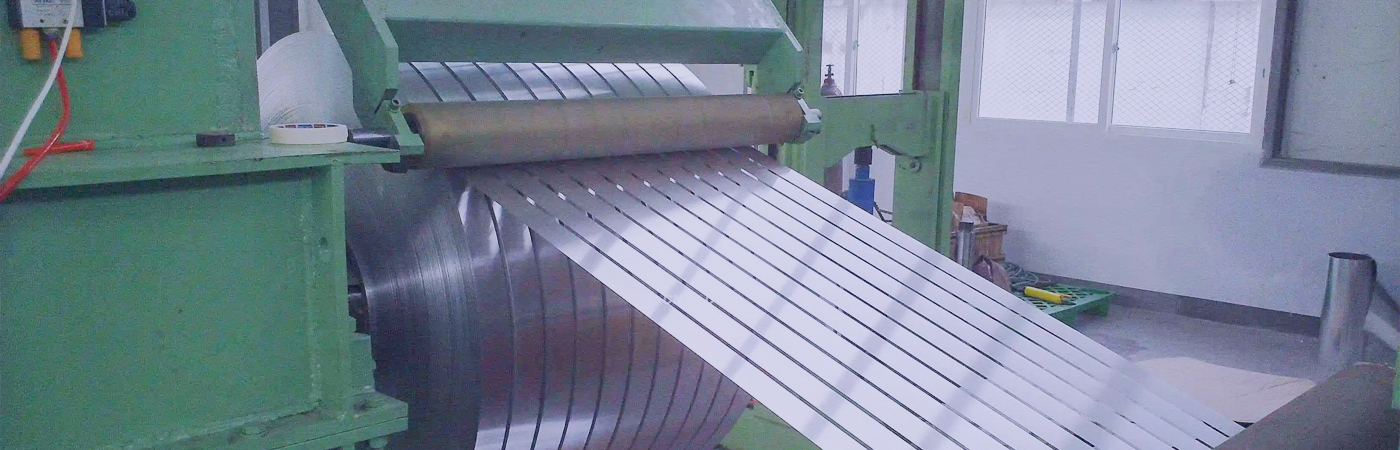
Aluminum Strip for Power Cable
In every cable segment of power transmission and communication engineering, there is an easily overlooked yet crucial component—aluminum tape.
The choice of cable aluminum strip is not accidental, but rather a result of the perfect match between the inherent properties of aluminum tape and the operational requirements of cables. Especially in terms of electromagnetic shielding, mechanical protection, cost control, and lightweight, aluminum tape has irreplaceable advantages, even surpassing copper and steel tapes in suitability for most cable scenarios.
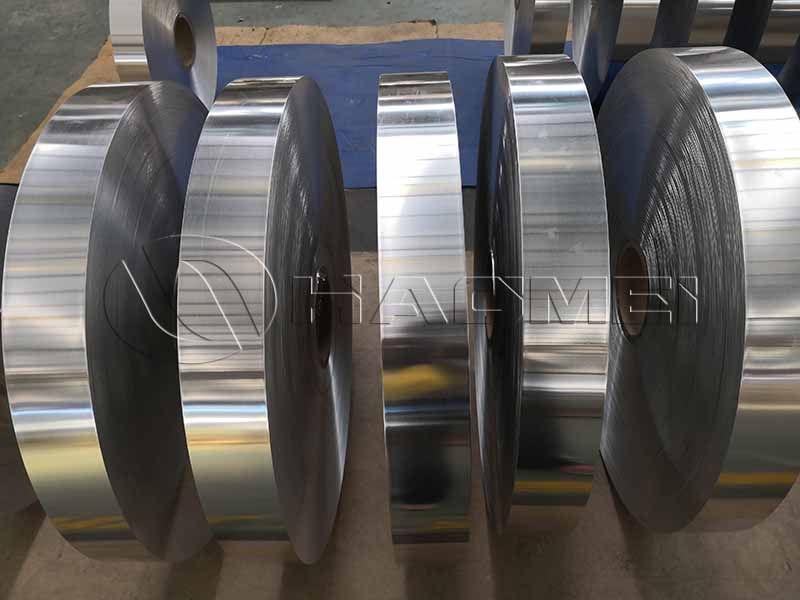
Four Core Advantages
First, superior electromagnetic shielding performance is the core competitiveness of aluminum tape. Cables transmitting power or signals are susceptible to external electromagnetic interference (EMI) and may experience internal signal leakage, affecting transmission quality; cables for medical equipment may experience interference that affects the accuracy of vital sign monitoring.
Aluminum tape has good conductivity (approximately 61% IACS of copper). When wound around the outer layer of the cable core, it forms a continuous conductive shielding layer, effectively reflecting and absorbing external electromagnetic signals while blocking internal signal radiation. It typically meets shielding effectiveness requirements of 30dB to 80dB, suitable for shielding needs in most low- and medium-frequency scenarios.
Secondly, reliable mechanical protection and environmental adaptability safeguard the cable. During installation (e.g., underground, tunnels, outdoor) and operation, cables inevitably encounter problems such as compression, friction, and moisture. Aluminum tape, with its excellent ductility and toughness, can tightly adhere to the cable structure, dispersing external pressure and preventing the cable from being flattened or punctured. Simultaneously, it works synergistically with the sheath to improve the overall tensile strength of the cable and reduce wear.
More importantly, aluminum forms a dense alumina protective film in air, possessing excellent corrosion resistance and able to withstand harsh environments such as humidity and salt spray. This makes it suitable for cables used in underground and offshore platforms, extending cable lifespan without the need for additional complex treatments.
Furthermore, its lightweight and low-cost advantages reduce cable manufacturing and installation costs. Aluminum's density is only 2.7 g/cm³, less than one-third that of copper. Using aluminum tape as a shielding or armoring material significantly reduces the overall weight of the cable, making it particularly suitable for weight-sensitive scenarios such as long-distance laying, high-altitude installations, or mobile equipment (e.g., charging cables for new energy vehicles), reducing transportation and installation difficulties.
Meanwhile, aluminum is significantly cheaper than copper. Replacing copper strip with aluminum strip, while maintaining performance, can substantially reduce cable manufacturing costs, especially for large-scale power and communication projects, where the cost advantage is particularly pronounced.
Finally, aluminum flat strip offers excellent processing and adaptability, meeting diverse cable requirements. Its excellent ductility and malleability allow it to be annealed to a soft state (O-state), making it easy to wind and bend. It adapts to cables of different specifications and shapes, ensuring a good fit even for flexible cables requiring frequent bending, preventing breakage or detachment due to bending.
Furthermore, aluminum strip can be slit into different widths and thicknesses according to cable requirements, offering convenient and high-precision processing to meet the needs of cables at various voltage levels, including low-voltage and high-voltage.
Common Cable Aluminum Tape Grades
Among aluminum tapes used in cables, 5-series aluminum tapes (aluminum-magnesium alloy) are the core choice for high-voltage and high-protection applications due to their excellent mechanical strength and corrosion resistance. 5052, 5154, and 5154A are the three most commonly used grades, each with its own performance focus, suitable for different harsh environments. Details are as follows:
1. 5052 Aluminum Strip: The most widely used 5-series aluminum tape, with an aluminum-magnesium alloy composition (magnesium content 2.6~3.6%). It represents a perfect balance between mechanical strength and flexibility, with a tensile strength of 100~150MPa, excellent elongation, and excellent corrosion resistance, allowing it to adapt to complex environments without additional anti-corrosion treatment.
Its moderate conductivity (approximately 48% IACS) meets the shielding requirements of medium- and high-frequency cables. It is primarily used as the shielding and armor layer for high-voltage power cables, submarine cables, and deeply buried underground cables, such as rail transit cables, offshore platform power supply cables, and high-voltage transmission cables in industrial parks. It effectively prevents cable damage under pressure and humid environments, extending its service life.
2. 5154 Aluminum Strip: Belonging to the same aluminum-magnesium alloy family as 5052, its magnesium content is slightly higher (3.1~3.9%), resulting in superior mechanical strength. Its tensile strength can reach 110~160MPa, and it has higher hardness and slightly improved corrosion resistance, especially in salt spray environments. Its flexibility is slightly lower than 5052, but it still possesses good processability, allowing for smooth winding and bending processes. It is suitable for applications requiring higher mechanical strength and corrosion resistance, such as deep-sea cables.
3. 5154A Aluminum Strip: 5154A features an optimized alloy composition compared to 5154, with strict control over impurity content, resulting in more stable and uniform performance. Its mechanical strength is essentially the same as 5154, but it offers superior corrosion resistance, processing precision, and slightly higher elongation, making it suitable for applications requiring extremely high stability in cable accessories, such as high-end high-voltage cables. Furthermore, 5154A exhibits better weldability, allowing for tighter integration with other cable components, further enhancing the overall protective performance and stability of the cable. It is widely used in high-end power and communication fields.
Original source: https://www.aluminumstrip24.com/news/aluminum-strip-for-power-cable.html
Tags: aluminium flat strip,
Previous: Black Aluminium Strips
Next: 2 Inch Wide Aluminum Strips